

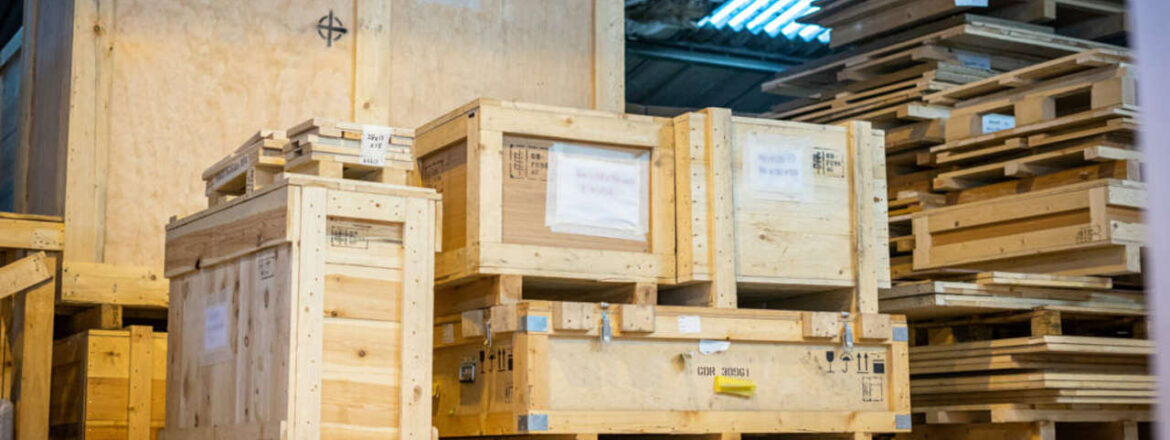
Every year, UAE exporters lose time and money because wooden crates are rejected at the destination port for missing ISPM-15 treatment. Total Packaging Solutions (TPS) has supported exporters across the UAE since 2009, holds ISO and ICV certification, and runs its own ISPM-15 heat treatment and fumigation facility in Musaffah, Abu Dhabi. Your crates are built, treated and marked in one place, with no outside provider to chase. If your next export uses wooden packaging, WhatsApp or contact us before the crates are built, not after they are rejected.
What ISPM-15 Actually Is
ISPM-15 is an international standard for treating wood packaging used in global trade. It exists to stop insects and pests from travelling inside raw timber and spreading to other countries.
Most major trading countries enforce it. If your wooden packaging does not meet the standard, the shipment can be held, treated at your cost, or sent back.
What Counts as Wood Packaging
The standard covers more than the outer crate. It applies to any solid wood used to pack, support or secure cargo:
- Wooden crates and boxes
- Pallets and skids
- Cable drums
- Dunnage and internal bracing
- Saddles and supports for pipes and cylindrical equipment
Plywood, OSB and particle board are generally exempt because they are made with glue, heat and pressure. Always confirm the rules of the destination country, since some inspectors check these materials as well.
The Two Approved Treatment Methods
Heat treatment (HT). The wood is heated until its core reaches at least 56 degrees Celsius and holds that temperature for a minimum of 30 continuous minutes. It leaves no chemical residue and is accepted almost everywhere.
Methyl bromide fumigation (MB). This is also approved under the standard, but some destination countries restrict or discourage it. For that reason, heat treatment is the safer default for most export shipments.
How to Read the ISPM-15 Mark
Treated wood carries a permanent stamp. It includes:
- The IPPC symbol
- The country code (AE for the UAE)
- A code identifying the treatment provider
- The treatment code (HT for heat treatment, MB for fumigation)
The wood must also be debarked, and the stamp must be clear and legible on at least two opposite sides of the package. If a customs officer cannot read it, they will treat the crate as untreated.
Where Exporters Go Wrong
Most rejections are caused by small oversights, not by ignoring the standard completely:
- Untreated bracing inside a treated crate. One untreated block can fail the whole container.
- Reused crates with faded or removed marks. If the stamp is not readable, the crate is not compliant.
- Repairs with untreated wood. A treated crate patched with ordinary timber loses its compliance.
- Crates built by a general carpenter. Wood from a source that is not an approved treatment provider cannot carry a valid mark.
- Checking requirements too late. Destination rules are easy to confirm before building and expensive to fix after.
A Scenario We See Regularly
An exporter packs machinery in crates built by a local carpenter. The outer timber is fine, but the internal bracing is cut from untreated wood. The container is inspected at the destination port, one brace fails, and the whole shipment is held.
The cost of treatment at the port, plus storage and delay charges, ends up higher than the cost of the crate itself. Treating every piece of wood at the start would have avoided all of it.
How to Avoid ISPM-15 Problems
- Confirm the destination country’s requirements before the crate is designed.
- Specify treated and marked wood for every component, including bracing and supports.
- Check the stamp on each crate before it is loaded.
- Keep treatment records with your shipping documents.
- Reuse crates only if the mark is intact and the wood is undamaged.
Frequently Asked Questions
ISPM-15 is an international standard for treating wood packaging used in cross-border trade. It applies to any solid wood crate, pallet, skid or bracing that travels with your export shipment.
Heat treatment is the safer choice for most shipments. It leaves no chemical residue and is accepted in nearly every destination country, while fumigation is restricted in some.
Plywood, OSB and particle board are generally exempt because they are manufactured with glue, heat and pressure. Some inspectors still check them, so confirm the destination rules before shipping.
Yes. TPS operates its own ISPM-15 heat treatment and fumigation facility in Musaffah, Abu Dhabi, so crates are built, treated and marked in one place.
ISPM-15 compliance is not complicated, but it is unforgiving. Every piece of solid wood in your shipment needs to be treated, marked and readable, including the parts nobody sees inside the crate. Confirm the destination rules early, specify treated wood from the start, and check the stamp before loading.
Total Packaging Solutions (TPS) builds, treats and marks export packaging at its own facility in Abu Dhabi, so compliance is handled before your cargo leaves. WhatsApp or contact our team to get ISPM-15 compliant crates for your next shipment.